
You might be surprised by this statement, but the crypto market in Iran—unlike the broader economy and many other markets—is growing.
Several factors such as inflation, international sanctions, the global growth of digital assets, and increasing public awareness of this high-potential market have contributed to the expansion of Iran’s crypto sector. In this analysis, we examine these drivers alongside real data on the growth of Iranian online cryptocurrency exchanges and their users, as well as the strategies employed by professional Iranian traders.

Iran’s Crypto Market Is Surging — Here’s What the Data Shows
Around six years ago, roughly in 2019, relatively few people in Iran were investing in crypto. Public understanding of the industry was often limited and many viewed it as a scam—an environment where people exchanged their money for numbers displayed on a screen.
However, as Iranian exchanges steadily expanded, public knowledge increased as well. Earning in USD is highly attractive in a country experiencing annual inflation of around 40%.
Today, on Google Play and Café Bazaar (an Iranian app marketplace), Iranian crypto exchange applications rank among the most downloaded apps. One of their primary uses is checking cryptocurrency prices in rials (IRR).
Additionally, Google Trends data shows a significant increase in searches related to cryptocurrencies and associated terms.
What’s Fueling the Boom Behind the Scenes?
A closer look at the market and the rising public awareness reveals several economic factors that have driven this growth in recent years.
Inflation and Currency Pressure
As noted, runaway inflation in Iran has led many people to turn to crypto and stablecoins such as USDT and DAI to preserve the value of their assets. Buying and selling these assets—whose value tracks the US dollar—is far easier than trading physical cash dollars within Iran.
This article does not explore the full comparison between buying USD and stablecoins, but factors such as ease of trading, lower fees, and fast, secure transfers have encouraged the general public to choose digital assets over physical dollars.
Limited Access to Global Banking
In recent years, Iran has faced extensive international restrictions. Many global banks have been unable or unwilling to serve Iranian individuals. As a result, cryptocurrencies have become a practical solution for accessing certain global financial services and conducting international transfers.
Consequently, many individuals use crypto for international payments, receiving payments for services, or earning income in USD instead of relying on services such as Visa or SWIFT.
Cryptocurrency can therefore be seen as a bridge connecting Iranian users to international payments.
How Smart Investors in Iran Are Positioning Themselves
Let’s take a closer look at how Iranian traders and investors are using crypto in practice, along with real-world examples.
Shift Toward Stablecoins
As mentioned earlier, stablecoins have firmly established themselves as the digital dollar in Iran. Many people still invest in cryptocurrencies and altcoins, but converting rials into digital dollars is fundamentally an anti-inflation strategy.
For example, if you held 1,000,000,000 IRR at the beginning of 2024 and converted it into digital dollars, you would have held approximately $1,000.
By the fourth month of 2025, that same $1,000 would be worth roughly 1,700,000,000 IRR.
This approach primarily preserves purchasing power rather than generating substantial profit, but it is the simplest method investors use to protect their wealth.
Arbitrage Opportunities
From a more professional perspective, arbitrage has long been a source of income for traders—and the emergence of Iranian exchanges has increased its potential. Many Iranian traders profit from price differences between domestic and international exchanges by rapidly buying and selling digital assets. This creates small but consistent gains that can become a strong income stream.
For example, some traders compare the price of Bitcoin in Iran with the price of Bitcoin on international exchanges and, upon observing a significant USD price difference, proceed with arbitrage.
Risk Diversification
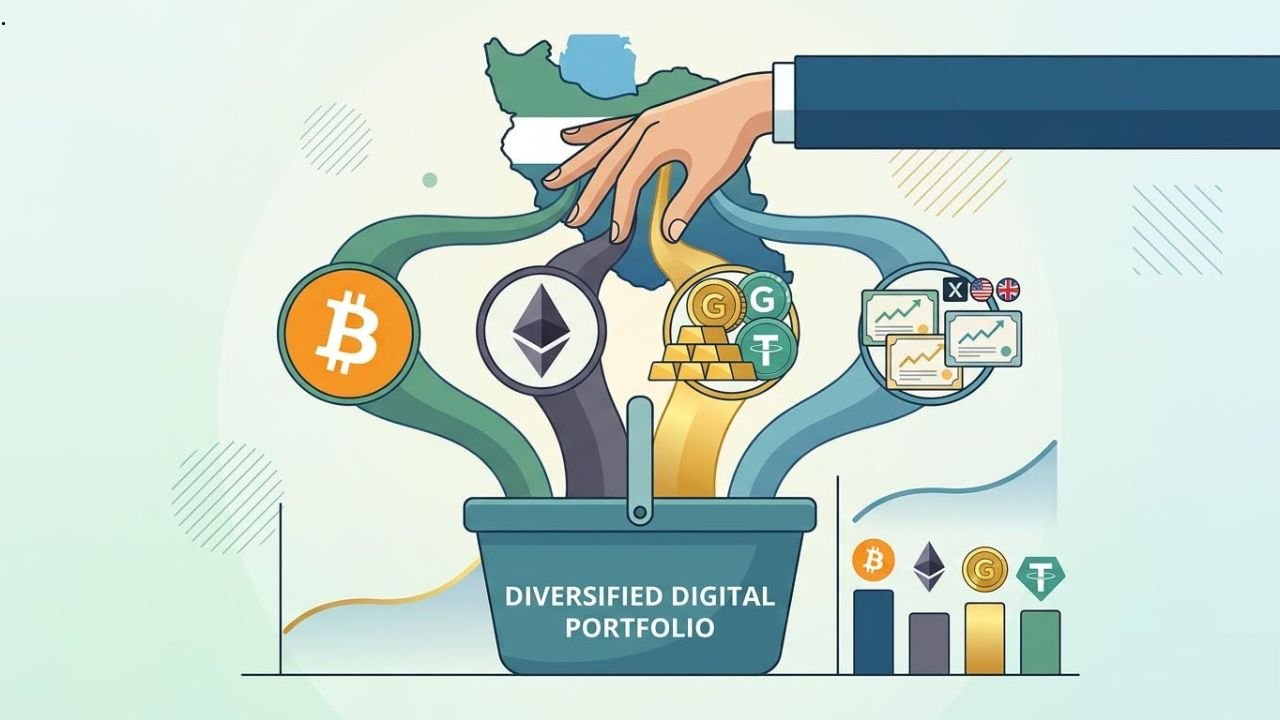
Portfolio diversification is one of the most important principles for reducing investment risk, and it can be implemented easily with digital assets. Iranian investors not only invest in Bitcoin as the leading cryptocurrency or Ethereum as the largest altcoin, but also purchase tokens such as PAXG and XAUT to gain exposure to global gold. This diversification has expanded further with the introduction of tokenized stocks (Xstock) to crypto markets by Robinhood.
What This Means for the Future of Iran’s Crypto Market
All of these factors point to continued growth in cryptocurrency adoption and investment in Iran. The intense competition among Iranian exchanges reflects this trend. These platforms innovate and sometimes offer rewards and trading bonuses to attract more users.
At the same time, Iranian traders and investors increasingly seek more diverse services, such as borrowing against staked assets or earning yield through crypto staking.
The crypto market will continue to grow—not only in Iran but globally—supported by global inflation and the demand for financial freedom.
(Conclusion) A Market Maturing Under Pressure
This article explored the growth of Iran’s cryptocurrency market and the factors driving it. This growth is not the result of short-term hype, but of economic foresight. With intensified international sanctions and the continued decline of the rial, Iranian users are turning more than ever to cryptocurrencies. Earning in USD has become a powerful tool for combating inflation.
Many previously speculative traders have evolved into patient investors, signaling a more dynamic, larger, and more professional market in Iran—where only the strongest companies will survive and the rest will fade away.